
China Internet Users: Monthly Income 2021
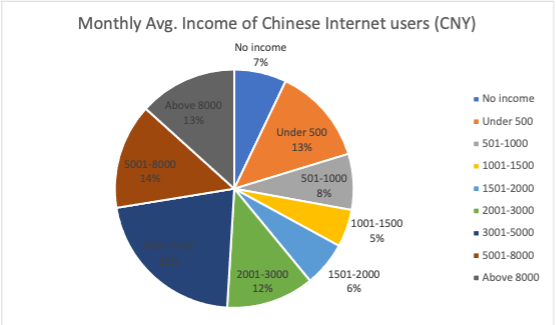
According to the latest 2021 statistics, 13.2% of the Chinese online users have monthly income below CNY 500 yuan;7.6% of the Chinese online users have monthly income between CNY 501-1000 yuan; 5.1% of the Chinese online...
On This Page
China Internet Users: Monthly Income 2021
Understanding the income distribution and purchasing power of China's digital population is crucial for international brands looking to enter or expand in the world's largest e-commerce market. In this comprehensive analysis, we delve into the latest 2021 statistics on the monthly income of Chinese online users, and the key implications for global brands.
Diverse Income Levels Across China's Digital Landscape
China's rapidly growing internet user base represents a highly diverse consumer landscape in terms of income levels. According to the latest 2021 data, the monthly income distribution of Chinese online users is as follows:
- 13.2% have monthly income below CNY 500 yuan (approx. USD 75)
- 7.6% have monthly income between CNY 501-1000 yuan (USD 75-150)
- 5.1% have monthly income between CNY 1001-1500 yuan (USD 150-225)
- 6.1% have monthly income between CNY 1501-2000 yuan (USD 225-300)
- 11.9% have monthly income between CNY 2001-3000 yuan (USD 300-450)
- 21.5% have monthly income between CNY 3001-5000 yuan (USD 450-750)
- 14.3% have monthly income between CNY 5001-8000 yuan (USD 750-1200)
- 13.3% have more than CNY 8000 yuan (USD 1200) per month
- 7.1% have no income
This data highlights the sheer scale and diversity of China's digital consumer base, presenting both opportunities and challenges for international brands. While the upper-middle and high-income segments offer significant purchasing power, brands must also cater to the needs of lower-income consumers to maximize their market reach.
Implications for International Brands
The income distribution of China's internet users has several key implications for global brands:
1. Tailored Product and Pricing Strategies
Brands must carefully assess the income profiles of their target audience and develop tailored product portfolios and pricing strategies to meet the diverse needs and purchasing power of Chinese consumers. This may involve offering entry-level, mid-range, and premium product lines, as well as leveraging localized pricing and promotional campaigns.
2. Innovative Digital Marketing Approaches
To effectively reach and engage with China's diverse digital population, brands need to adopt innovative and multi-faceted marketing strategies. This may include leveraging social media platforms, influencer marketing, live-streaming, and e-commerce integrations to connect with consumers across the income spectrum.
3. Omnichannel Retail Experiences
Providing seamless and personalized shopping experiences across both online and offline channels is crucial for brands to cater to the evolving purchasing behaviors of Chinese consumers. This may involve integrating e-commerce, brick-and-mortar stores, and innovative retail formats such as pop-ups and experience centers.
4. Localized Content and Partnerships
Brands must create localized content and collaborate with relevant partners to build trust and resonance with their target audience. This could include working with key opinion leaders (KOLs), leveraging regional e-commerce platforms, and developing culturally relevant marketing campaigns.
Key Takeaways for International Brands
As international brands navigate the dynamic Chinese market, the following key takeaways can help guide their strategies:
- Understand the diverse income profiles: Conduct in-depth research to identify the unique income segments within your target audience and tailor your offerings accordingly.
- Adopt a multi-tiered approach: Develop a product and pricing portfolio that caters to consumers across the income spectrum, from entry-level to premium segments.
- Leverage innovative digital channels: Leverage China's dynamic digital landscape to connect with consumers through targeted social media, influencer marketing, and e-commerce integrations.
- Provide seamless omnichannel experiences: Integrate online and offline touchpoints to deliver personalized and convenient shopping experiences for your customers.
- Embrace localization and partnerships: Collaborate with local partners and create culturally relevant content to build trust and resonance with your target audience.
Conclusion
The diverse income distribution of China's internet users presents both challenges and opportunities for international brands. By understanding the unique income profiles of their target audience and adapting their strategies accordingly, brands can unlock the vast potential of this dynamic and rapidly evolving market. Through a combination of tailored product offerings, innovative digital marketing, seamless omnichannel experiences, and localized partnerships, brands can position themselves for long-term success in China.
Ready to Apply These Insights?
Talk to our China marketing experts and get a strategy tailored to your brand.
Related Articles

618 Shopping Festival 2025: A Strategic Shift in A Digital Shopping Ecosystem in China
The mid‑year 618 Shopping Festival has evolved far beyond a simple discount event. This year, it became a strategic showcase highlighting how Chinese e-commerce is redefining itself through smarter spending, advanced tech, high‑impact content, policy...
19 Jun 2025

China Car Market Report 2023H1
In recent years, China's automotive industry has experienced fast transformation. Technological alliances and partnerships becoming an increasingly focus in each brand's strategy.
3 Oct 2023

How to Write Better Chinese Ad Copies
When writing creative ad copy for the Chinese market, we need to closely consider the audiences, the culture differences, the brand proposition, the product features, creatives and the user journeys. Different products and user journeys caused differ...
28 Sept 2023