
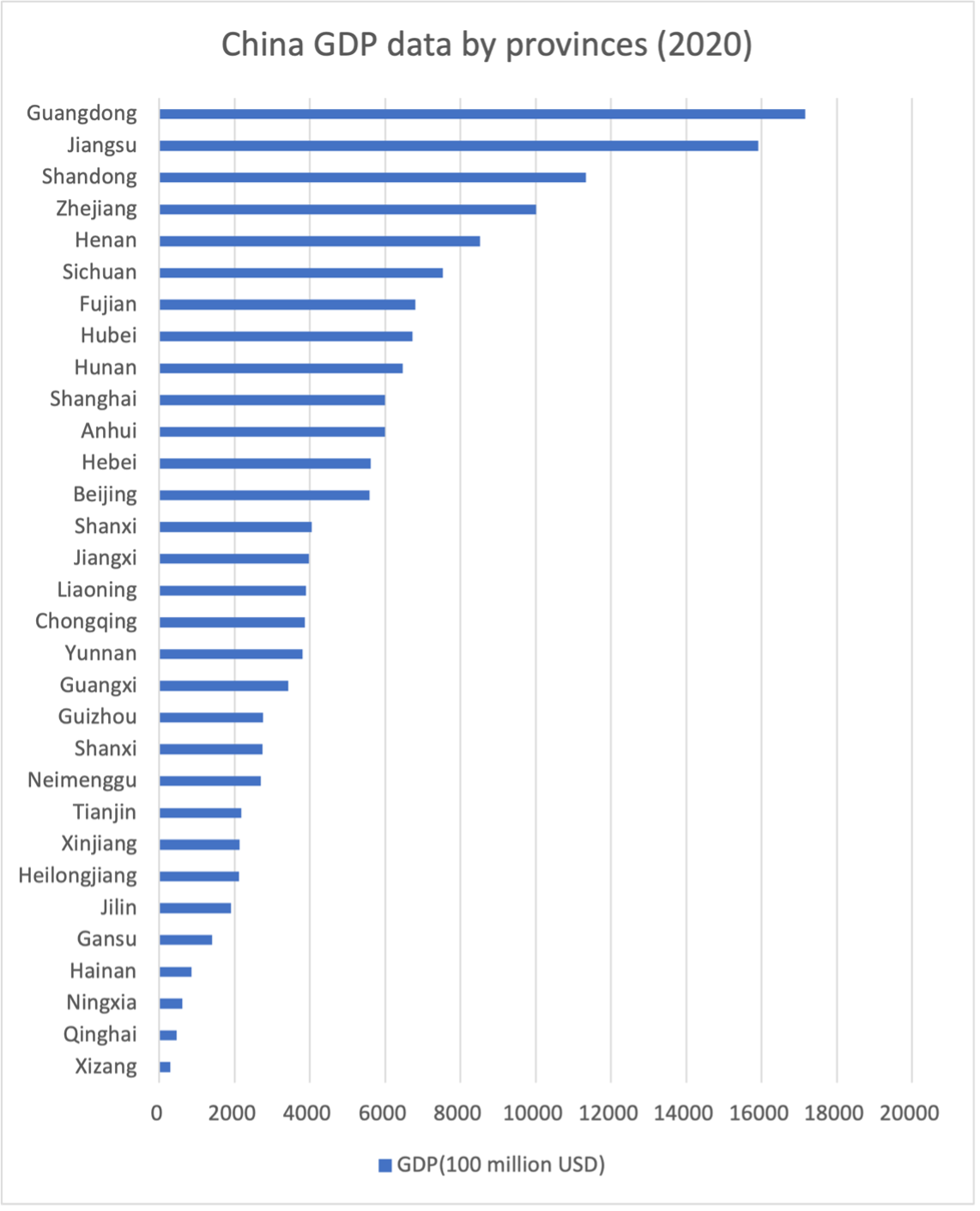
GDP by provinces in mainland China 2020
The 2020 GDP by Mainland China's provinces:The top 10 :Guangdong Province is $17157 billion, Jiangsu Province is $15911 billion, Shandong Province is $1132.8 billion, Zhejiang Province is $10009 billion, Henan Province is $851.9 billion, Sichuan Prov...
On This Page
GDP by Provinces in Mainland China 2020
China's economy has experienced remarkable growth over the past decades, with the country now being the world's second-largest economy. Understanding the economic landscape at the provincial level is crucial for international brands looking to enter or expand their presence in the Chinese market. In this comprehensive article, we will delve into the 2020 GDP data for China's provinces, highlighting the key trends and insights that can inform strategic decision-making for businesses.
Top 10 Provinces by GDP
According to the latest available data, the top 10 provinces in mainland China ranked by GDP in 2020 are as follows:
- Guangdong Province: $17,157 billion
- Jiangsu Province: $15,911 billion
- Shandong Province: $11,328 billion
- Zhejiang Province: $10,009 billion
- Henan Province: $851.9 billion
- Sichuan Province: $752.8 billion
- Fujian Province: $680.1 billion
- Hubei Province: $672.9 billion
- Hunan Province: $647.2 billion
- Shanghai: $599.5 billion
Provinces Ranked 11-20 by GDP
Rounding out the top 20 provinces by GDP in 2020 are:
- Anhui Province: $599.2 billion
- Hebei Province: $560.8 billion
- Beijing: $559.2 billion
- Shanxi Province: $205.5 billion
- Jiangxi Province: $398.0 billion
- Liaoning Province: $389.0 billion
- Chongqing: $387.3 billion
- Yunnan Province: $379.8 billion
- Guangxi Province: $343.2 billion
- Guizhou Province: $276.1 billion
Provinces Ranked 21-31 by GDP
Rounding out the list of provinces in mainland China, the GDP figures for the remaining 11 provinces are as follows:
- Shaanxi Province: $273.4 billion
- Neimenggu: $268.9 billion
- Tianjin: $218.1 billion
- Xinjiang: $213.7 billion
- Heilongjiang: $212.2 billion
- Jilin: $190.7 billion
- Gansu: $139.7 billion
- Hainan: $85.7 billion
- Ningxia: $60.7 billion
- Qinghai: $46.5 billion
- Tibet: $29.5 billion
Key Insights for International Brands
The provincial GDP data provides valuable insights for international brands looking to enter or expand their presence in the Chinese market:
- Concentrate on the economic powerhouses: The top provinces by GDP, such as Guangdong, Jiangsu, and Shandong, should be prioritized as they offer the largest consumer bases and economic opportunities. These regions are home to China's most prosperous cities and boast robust infrastructure, talent pools, and consumer spending power.
- Explore high-growth regions: While the top provinces are essential, international brands should also consider high-growth provinces like Sichuan, Fujian, and Hubei. These regions are experiencing rapid economic development and offer untapped potential for market expansion.
- Adapt to regional differences: China is a vast and diverse country, and regional differences in consumer behavior, purchasing power, and market dynamics can be significant. International brands should carefully research and understand the unique characteristics of each province to develop tailored strategies that resonate with local consumers.
- Leverage the rise of lower-tier cities: While the top-tier cities like Shanghai and Beijing are crucial, international brands should also explore opportunities in lower-tier cities, which are often more cost-effective and offer growing consumer markets. Provinces like Henan, Sichuan, and Hunan have a large population and are undergoing rapid urbanization, presenting exciting prospects for brands willing to invest in these emerging markets.
- Collaborate with local partners: Navigating the complexities of the Chinese market can be challenging for international brands. Partnering with local agencies, distributors, or e-commerce platforms can provide valuable insights, resources, and access to target consumers in each province.
Conclusion
The 2020 GDP data for China's provinces paints a comprehensive picture of the country's economic landscape, highlighting the vast opportunities and regional differences that international brands must consider when entering or expanding in the Chinese market. By understanding the strengths and growth potential of each province, companies can develop targeted strategies to capitalize on the unique advantages and consumer preferences of these dynamic regions. As the Chinese economy continues to evolve, staying agile and adaptable will be key for international brands seeking long-term success in this rapidly changing market.
Ready to Apply These Insights?
Talk to our China marketing experts and get a strategy tailored to your brand.
Related Articles

618 Shopping Festival 2025: A Strategic Shift in A Digital Shopping Ecosystem in China
The mid‑year 618 Shopping Festival has evolved far beyond a simple discount event. This year, it became a strategic showcase highlighting how Chinese e-commerce is redefining itself through smarter spending, advanced tech, high‑impact content, policy...
19 Jun 2025

China Car Market Report 2023H1
In recent years, China's automotive industry has experienced fast transformation. Technological alliances and partnerships becoming an increasingly focus in each brand's strategy.
3 Oct 2023

How to Write Better Chinese Ad Copies
When writing creative ad copy for the Chinese market, we need to closely consider the audiences, the culture differences, the brand proposition, the product features, creatives and the user journeys. Different products and user journeys caused differ...
28 Sept 2023