Introduction
For international brands entering China, Baidu has always been the unavoidable gateway. With over 70% of China's search market and more than 650 million monthly active users, it remains the single most important platform for brand discovery in China.
But in 2026, the Baidu that international marketers knew has fundamentally transformed. The old playbook — keyword stuffing, paid link building, and meta tag optimisation — is no longer sufficient. Baidu has become an AI-first platform, with generative search, intelligent content recommendations, and machine learning-powered ranking algorithms reshaping how brands get discovered.
The most significant change? Baidu now generates AI answers for approximately 40% of all search queries, displaying them prominently above traditional organic results. This shift has compressed organic click-through rates (CTR) while creating new opportunities for brands that understand how to optimise for Baidu's AI layer.
This article provides a comprehensive, practical update on Baidu SEO in 2026, covering algorithm changes, AI search optimisation, and actionable strategies for international brands.
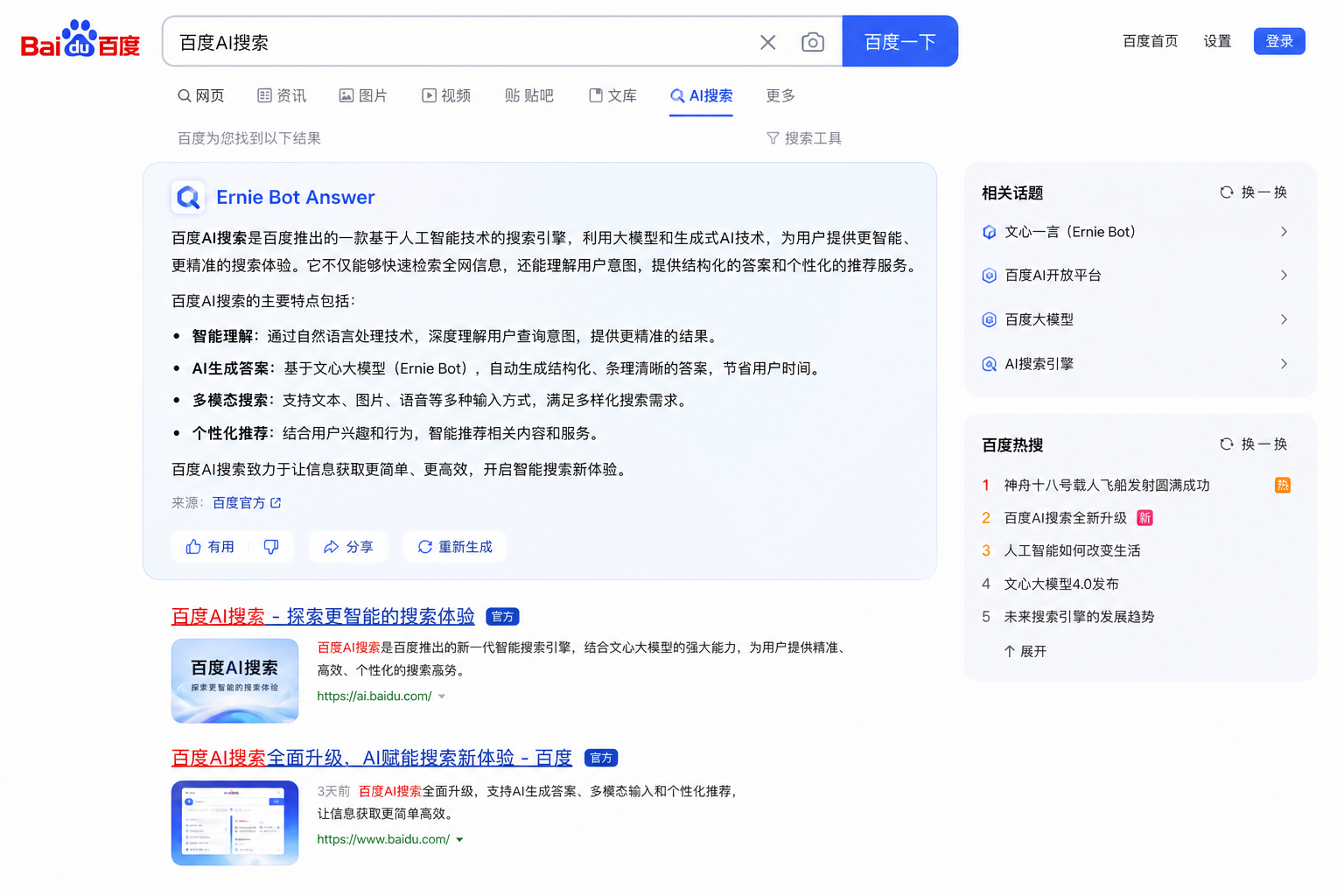
Baidu's AI Search Transformation: What Changed in 2025-2026
The Ernie Bot Integration
In early 2025, Baidu completed the full integration of its Ernie Bot (文心一言) LLM into core search results. This integration manifested in three key formats:
- AI Overview Boxes (AI智能摘要) — Summarised answers appearing at the top of SERPs, synthesising information from 3-7 sources
- Conversational Continuation (对话续问) — Follow-up question suggestions that keep users within Baidu's ecosystem
- Document-Level AI Analysis (文档级AI分析) — The ability to analyse entire web pages and extract key insights, reducing the need for users to click through
The impact on organic traffic has been dramatic. According to Baidu's 2025 annual report, AI-generated content now handles 40% of query completions, and average organic CTR for positions 1-3 has dropped from 35% to approximately 22%.
Ranking Algorithm Updates
Baidu's ranking algorithm, codenamed "Hengyue 3.0" (恒跃3.0), introduced several critical changes in late 2025:
- Content Authenticity Score (内容真实性评分) — A new metric evaluating factual accuracy. Content with verified citations and authoritative sources receives ranking priority
- User Satisfaction Index (用户满意度指数) — Based on dwell time, interaction rates, and follow-up query abandonment. High satisfaction content ranks better regardless of traditional SEO signals
- Entity Knowledge Graph Integration (实体知识图谱) — Baidu now cross-references web content against its proprietary knowledge graph. Content that aligns well with known entities receives ranking boosts
- Mobile-First Deep Crawling (移动优先深度抓取) — Baidu's crawler now processes mobile versions exclusively for ranking decisions in 90% of categories
The New Baidu SEO Ranking Factors (2026 Edition)
Based on extensive testing and analysis, here are the confirmed ranking factors for Baidu SEO in 2026, ranked by importance:
Top-Tier Factors (Critical)
Content Authority (权威性) — Baidu's AI now evaluates source authority more rigorously. Domain Authority (百度权重) considers real-world brand recognition, Baidu Baike presence, and cross-platform citation frequency
User Engagement Signals (用户互动信号) — Click-through rate, dwell time (target: 120+ seconds), scroll depth, and page interaction rates directly influence rankings
Mobile Experience (移动端体验) — Core Web Vitals for Baidu include: Largest Contentful Paint < 2.5s, First Input Delay < 100ms, and Cumulative Layout Shift < 0.1. Baidu specifically penalises pages with intrusive interstitials
Second-Tier Factors (Important)
Simplified Chinese Content Quality (简体中文内容质量) — Baidu's NLP models are increasingly sophisticated. Content must use correct, natural Simplified Chinese. Machine-translated content with awkward phrasing is penalised
Structured Data Implementation (结构化数据) — Baidu recognises Article, Product, FAQ, HowTo, BreadcrumbList, and Organisation schema. FAQ schema is particularly impactful for featured snippet acquisition
Backlinks with Context (上下文相关外链) — Baidu now evaluates the semantic context of backlinks. Links from thematically relevant pages carry significantly more weight than generic directory links
Freshness & Content Velocity (内容更新频率) — Content published within the last 90 days receives a ranking bonus for competitive keywords. Regular publishing (2+ articles/week) signals active authority
Third-Tier Factors (Supplementary)
ICP License Display (ICP备案展示) — Proper ICP license display in the website footer is a baseline trust signal
SSL/HTTPS — Baidu now prefers HTTPS by a small but measurable margin
Social Signals (社交信号) — While less important than direct engagement, WeChat shares and interactions correlate with higher rankings for content-oriented queries
Optimising for Baidu AI Overview (AI智能摘要)
With AI Overviews occupying the most visible SERP real estate, optimising for inclusion has become a critical SEO strategy:
How to Get Featured in Baidu AI Answers
Answer Questions Directly and Early — Baidu's AI extracts answers from content that directly addresses user queries in the first paragraph of a section. Structure content as explicit question-answer pairs
Use Clear, Factual Language — AI Overviews prefer content with concrete claims supported by data. Phrases like "According to [source]," "Data from [institution] shows," and "Industry standards indicate" increase citation probability
Maintain Reading Level Accessibility — Baidu's AI favours content written at a grade 8-10 reading level in Chinese. Overly technical or overly simplistic content is less likely to be featured
Include Multiple Perspectives — AI Overviews that synthesise multiple viewpoints are considered more valuable. Content that presents both sides of an argument or multiple data sources is prioritised
The AI Overview Audit Process
Regularly audit your brand's presence in Baidu AI answers:
Step 1: Identify 20-30 high-value keywords for your brand Step 2: Search each on Baidu and document AI Overview presence Step 3: If an AI Overview exists, note whether your brand is cited Step 4: For uncited keywords, create content targeting AI Overview format Step 5: Re-audit monthly and track inclusion rate improvement
Baidu SEO Technical Requirements for 2026
Hosting and Infrastructure
Baidu now requires that websites targeting Chinese users have hosting in mainland China with a valid ICP license. CDN services like Baidu Cloud Accelerate (百度云加速) provide the best performance for Baidu crawling:
- Server location: Mainland China
- ICP license: Required (Baidu explicitly warns non-ICP sites)
- Page load speed: Under 3 seconds on 4G networks (test via Baidu Mobile Friendliness Tool)
- Crawl budget optimisation: Submit Sitemap via Baidu Webmaster Tools, prioritise important pages, remove low-value pages
Content Submission
- Baidu Webmaster Tools (百度资源平台) — Required for all serious SEO efforts. Submit Sitemaps, monitor crawl stats, and review manual actions
- Baidu MIP (移动加速页面) — While less critical than in previous years, MIP still provides a slight ranking preference for mobile pages
- Baidu Xua (熊掌号 Submission) — Integrated into Webmaster Tools, this allows priority indexing submission for new content
Avoiding Baidu Penalties in 2026
Baidu's AI-powered penalty detection has become more sophisticated. The following practices carry significant risk:
- AI-Generated Content (AI生成内容) — Baidu now explicitly warns against purely AI-generated content. While AI-assisted content is acceptable, content must have genuine human editorial oversight. Baidu's detectors identify AI-generated patterns with over 95% accuracy as of 2026
- Excessive Interlinking (过度内链) — Pages with more than 100 internal links or links with >15% link-to-content ratio are flagged
- Keyword Over-Optimisation (关键词过度优化) — Keyword density above 3% in Chinese text triggers Baidu's content quality penalties
- Paid Links (购买外链) — Baidu's Penguin-like algorithm (绿萝算法) actively detects and devalues paid link networks
Action Plan: Baidu SEO for International Brands in 2026
Immediate (Week 1-2)
- Verify Baidu Webmaster Tools account and submit Sitemap
- Audit current Baidu rankings for priority keywords
- Check ICP license validity
- Run Baidu Mobile Friendliness Test
- Install Baidu Analytics (百度统计)
Short Term (Month 1-2)
- Rewrite top 10 priority pages for AI Overview optimisation
- Implement structured data (Article, FAQ, Product schema)
- Begin publishing 2 articles/week on China-focused topics
- Create Baidu Baike entry (if not existing)
- Optimise page speed for Chinese networks (CDN, image compression, code splitting)
Medium Term (Month 3-6)
- Develop a Chinese content strategy aligned with GEO principles
- Build authority signals through Zhihu and WeChat publication
- Implement regular AI Overview audits
- Expand to Baidu PPC (百度竞价) for competitive keywords
- Set up conversion tracking and attribution
Long Term (Month 6+)
- Develop multilingual SEO for Baidu (English brands in Chinese search)
- Explore Baidu's image and video search optimisation
- Build brand authority signals across China's digital ecosystem
Conclusion
Baidu SEO in 2026 is not the discipline it was in 2024. The platform's transformation into an AI-first search experience has rewritten the rules of engagement. International brands that succeed on Baidu will be those that embrace content authority, user experience, and AI optimisation — not as separate initiatives, but as a unified digital strategy for China.
The fundamentals remain: quality content, proper technical setup, and consistent effort. But the tactics — how we structure content, what we prioritise, and how we measure success — have fundamentally shifted. Brands that adapt to Baidu's AI era will capture the attention of 650 million monthly active users. Those that don't will watch their organic traffic evaporate.
Need help navigating Baidu SEO in the AI era? YIVA Digital's China search marketing team has been optimising for Baidu since 2008 — and we're at the forefront of AI search adaptation. Get in touch →
Published by YIVA Digital — Your partner for China market entry and growth since 2008.